🐶 Dog brains, decoded
What Is My Dog Thinking?
Your dog is thinking about you. A lot. Possibly more than is reasonable.
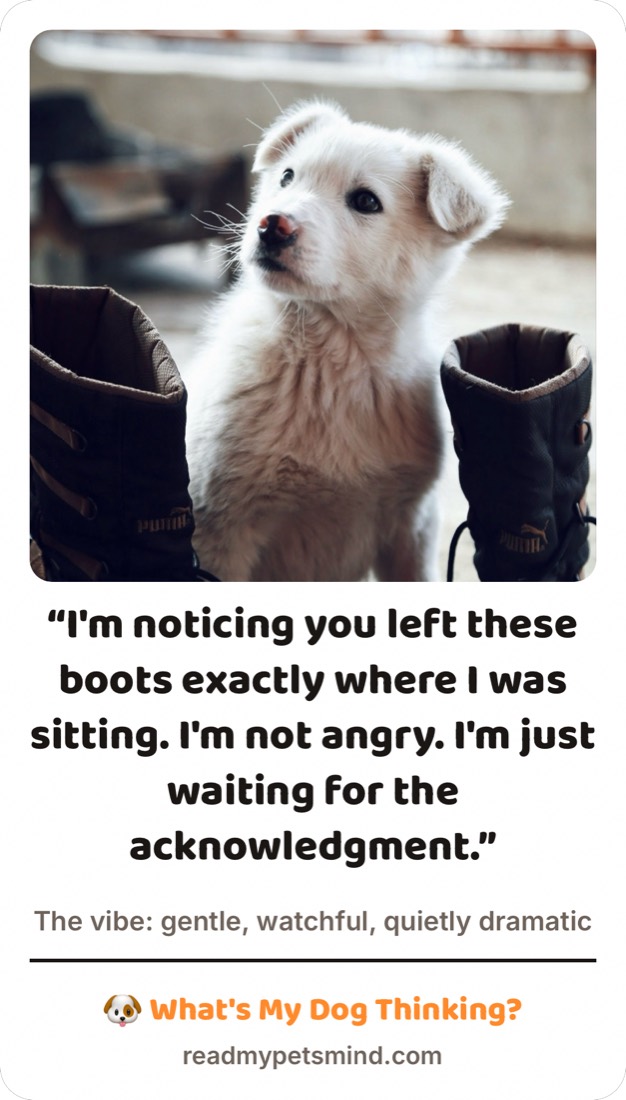
Dogs are watching your face constantly
Dogs are unusually good at reading humans — better than chimpanzees are, in several studies of following human pointing gestures. Thousands of years of living alongside us selected for animals that pay close attention to what our faces and hands are doing.
So when it feels like your dog is studying you, it's because it is. It's tracking your posture for signs of a walk, your voice for a tone change, and the specific drawer that contains the leash.
The "guilty look" is not guilt
This one disappoints people, so brace yourself. In a well-known experiment, dogs showed the classic "guilty" display — ears back, head low, avoiding eye contact — based on whether they were being scolded, not on whether they'd actually done anything wrong. Innocent dogs who got told off looked just as guilty as the real culprits.
What you're reading as a confession is appeasement behaviour: your dog has correctly identified that you are angry and is trying to de-escalate you. It isn't piecing together a timeline about the bin.
Leaning, following and the shadow problem
Dogs are a social species that evolved to stay physically close to their group. Leaning on your leg, sleeping touching you and following you room to room are all ordinary affiliative behaviour — your dog maintaining contact with its unit.
Worth knowing where the line is: contented following is relaxed. A dog that becomes distressed, destructive or vocal specifically when left alone may be dealing with separation anxiety, which is a genuine welfare issue and worth raising with a vet or a qualified behaviourist rather than waiting out.
They understand more words than you give them credit for
The average family dog learns well over a hundred words and cues. Some exceptional dogs — famously a border collie named Chaser — have been documented learning over a thousand object names and retrieving them correctly on request.
Your dog has almost certainly worked out the spelled-out version of "walk" by now, along with the sound of the specific cupboard, the jingle of the specific keys, and the exact tone you use on the phone when you're about to leave.
So what's the actual thought?
Something warm, repetitive and almost entirely about the present moment. Dogs aren't holding grudges or drafting plans. The internal monologue is closer to a running enthusiastic commentary on what's happening right now, who's here, and whether any of it might lead to food.
They are, bluntly, nicer than us.
Quick answers
Does my dog know I love him?
Dogs show a measurable oxytocin increase during friendly eye contact with their owners — the same hormonal loop involved in human bonding. They register the affection, even if they cannot name it.
Why does my dog sigh?
A long sigh as a dog settles is usually simple contentment and relaxation. Repeated sighing paired with restlessness or pacing is worth mentioning to your vet.
Do dogs remember things from years ago?
Dogs have strong associative memory — people, places and routines stick. What they appear to lack is our kind of detailed episodic recall of specific past events.